
Application ownership looks straightforward on a slide. Attach a person to every application. Ask that person to watch for newer versions and, on a regular cadence, confirm whether an update is worth deploying. Across an estate of several hundred applications, the payoff is a current, trustworthy picture of what is up to date and what is falling behind.
The trouble starts after the slide. A program rarely stays as tidy as it looked at launch, and the drift is quiet enough to be well underway before anyone names it. Here is what actually happens, why your coverage dashboard is probably lying to you, and what a healthy program looks like instead.
A Program That Looks Healthy on the Surface
A big push hands applications out to owners, and the coverage number climbs fast. Leadership sees a fully assigned portfolio and checks the box. Attention moves elsewhere, and that is exactly when the drift begins.
Say it plainly: Application ownership coverage is a vanity metric. “100% of applications have an owner” tells you that a name is attached to a record. It says nothing about whether that person has looked at the application this quarter. An enterprise may run hundreds, if not thousands, of applications, and a single engaged owner can realistically manage only a finite number. The gap between assigned and actually watched is where the risk lives.
The Owners Who Never Engage
Take the owners who never really engage. A tempting assumption is that the problem is a lack of nudging, but the reminders do go out. The real issue is quieter. Application ownership is rarely a full-time job. It is a task bolted onto the side of a real role, and side tasks are the easiest things in the world to forget. A reminder, competing with a full inbox and a day of meetings, loses again and again.
Sometimes the owner does not even know the app is theirs. A finance reporting tool gets attached to someone who changed teams over a year ago, and the reminders land in an inbox no one treats as their responsibility. The owner is not refusing to help. The task simply never reaches the top of the pile.
From a manager's chair, the missing piece is not another email. It is a clear view of who has never engaged at all, so a quiet conversation can happen, support can be offered, or the workload can be rebalanced before the application falls behind.
The Reliable Owners Who Quietly Get Overloaded
The opposite problem shows up too. Reliable people attract more work, precisely because reliability invites the next assignment, and the next. Picture an infrastructure engineer who, over two years, quietly accumulates a further 15 applications on top of her day job. Her coverage looks perfect. In practice, she actively watches six of them and waves the rest through. When she takes three weeks of leave, no one notices that a third of “hers” are now unwatched, until a vendor ships a critical patch and nobody acts on it.
What the dashboard hides is the overload and the risk of having so much depend on one person. A role change, a long absence, or a departure can leave a large slice of the portfolio unwatched overnight.
The Everyday Slippage
Underneath all of that sits the everyday slippage. A check-in due Monday lands on Thursday. The next one runs two weeks late. The check-in after that never arrives. No single lapse is worth raising a flag over. The lapses pile up anyway, until “overdue” has quietly become the normal state, the work of staying current falls behind, and the data the program depends on no longer matches reality.
How Application Ownership Drift Actually Feels
For the IT manager or admin responsible for the program, the drift never appears as a tidy chart. It shows up as a string of small, recurring frustrations:
-
Leadership asks a simple question: Is the program actually working? An honest answer is hard to give. There is a coverage number and a quiet suspicion that it hides more than it reveals.
-
A chronically disengaged owner surfaces only when something breaks, an auditor asks, or a vulnerability is found in an application left unreviewed for some time.
-
Hours disappear into chasing people by hand, guided by memory and gut feel about who responds and who has gone quiet, because no system says so plainly.
-
The true cost of concentration becomes clear the day a key person resigns, and the scale of what sat with that one person finally adds up.
- Reporting describes applications in detail and stays oddly quiet about the people behind the estate.
How To Spot Application Ownership Drift Early
Longevity has little to do with the coverage stat on launch day. The programs that endure are the ones where a quick glance reveals, early, that engagement has started to wobble, in time to act before a small problem grows into a real one.
-
You can run a rough health check today without any new software. Ask:
-
Who received applications and never started? Is the load shared sensibly, or balanced on too few shoulders?
-
Where are owners beginning to slip, before that slip hardens into a compliance problem?
-
Do I know which applications actually need an owner in the first place?
If answering those means exporting a pile of data and stitching it together by hand, that is the real signal: the information a healthy program runs on is exactly the information that is hardest to see.
From Application Visibility To Program Health
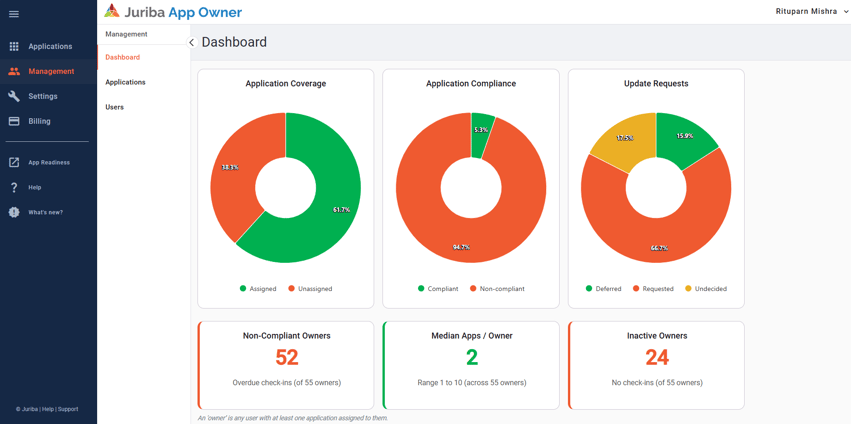
This is the gap Juriba App Owner is built to close. Instead of another coverage percentage, the management dashboard answers the three questions a manager actually asks: who was assigned applications and never engaged, who is carrying too many, and who has started to slip. Owners who go quiet or leave the company are flagged automatically, so a name does not disappear from the estate unnoticed.
It is not magic, and it does not replace the manager. It will not make a disengaged owner care, and the picture is only as accurate as the data feeding it. What it does is end the manual export-and-stitch ritual and put the people side of the program in front of you in seconds. At $1 per device, that is usually trivial against the cost of a single missed update on an unowned, internet-facing application.
Application ownership programs do not have to drift off course. If you want to see exactly what the latest dashboard surfaces, the new release notes cover what is available today.
Key takeaways
- Application ownership coverage is a launch-day vanity metric. Owner engagement over time is what keeps a program alive.
- Most disengaged owners are not refusing to help. Ownership is a side task that loses to a full inbox.
- Reliable owners quietly get overloaded, which concentrates risk on one person.
- You can run a manual health check today; tooling like App Owner ($1/device) mainly removes the manual effort.

Frequently asked questions
What is application ownership?
Application ownership is the practice of assigning a named person to each application in an organization's portfolio. That owner monitors new versions, confirms whether updates should be deployed, and keeps the application current and secure.
Why do application ownership programs drift or fail?
They rarely fail loudly. Programs drift when owners disengage because ownership is a side task, when reliable owners get overloaded, and when small, repeated check-in delays accumulate, until “overdue” becomes normal and the program's data no longer matches reality.
What does an application ownership program typically cost?
Running an ownership program well mostly costs managers' time today. Juriba App Owner is priced at $1 per device, which is generally small against the cost of a single missed update on an unowned application or an audit finding on an unreviewed one.
How many applications can one owner realistically manage?
There is no fixed number, but concentration is a risk. When one person carries dozens of applications, real attention gets rationed, and a single departure can leave a large part of the portfolio unwatched. Balancing the load matters more than any single cap.

.png?width=6668&height=3748&name=AI%20Featured%20Image_AIJournal_Article%20(1).png)
.png?width=1200&height=627&name=Mythos_Featured%20Image_Blog_The%20AI%20Patch%20Wave%20Head%20of%20EUC%20(2).png)