
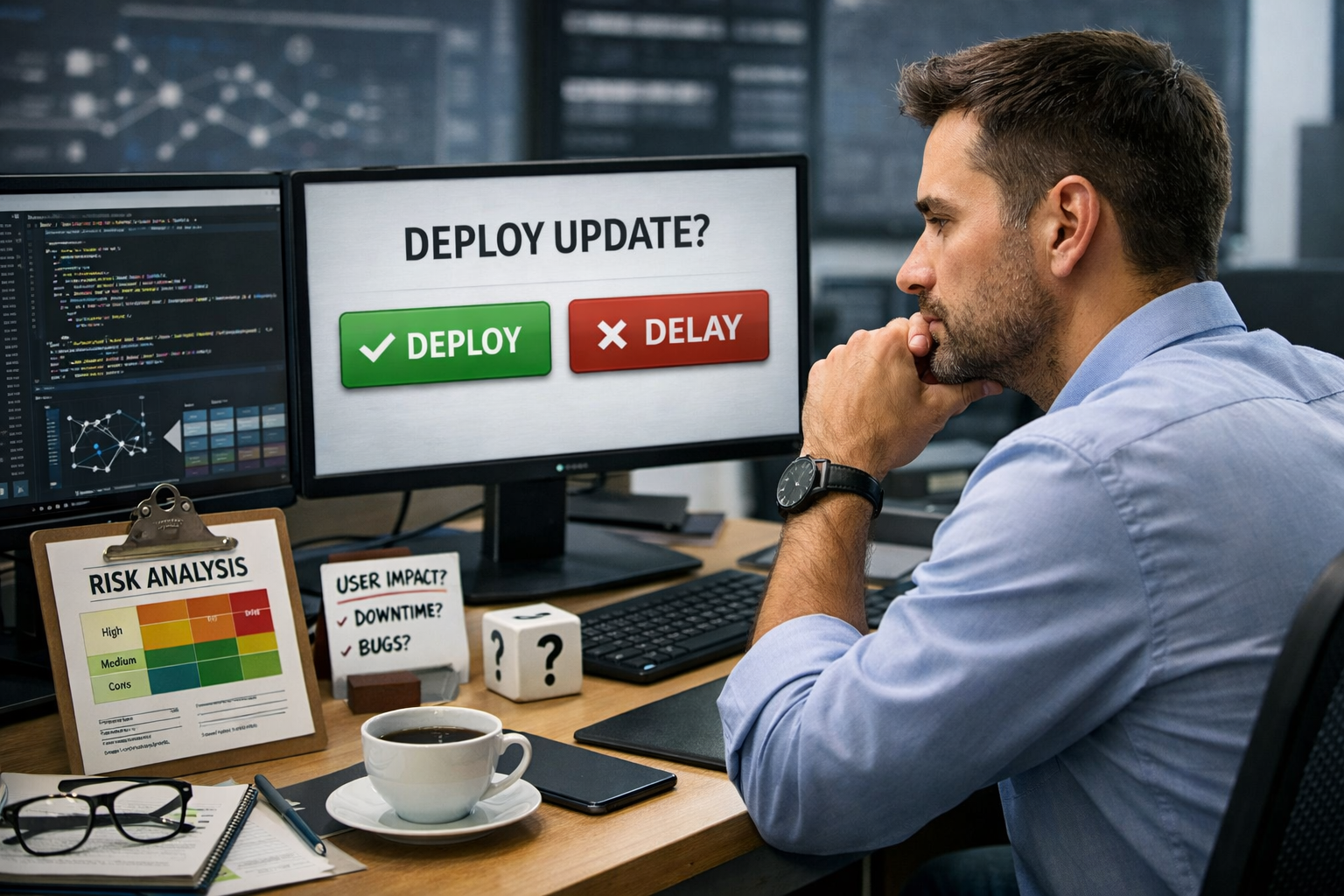
When packaging becomes faster, the challenge changes. The question is no longer just whether the team can produce deployable packages quickly enough. It becomes about deciding what should move into the environment and when, without creating unnecessary risk.
That is an important shift. A well-built package is only part of the job. Even technically sound updates can create issues at scale, interact badly with local dependencies, or arrive at the wrong time for the business. As packaging speed improves, change control has to evolve with it.
Why Traditional Change Control Breaks at Scale
Traditional change control works reasonably well when the number of changes is limited, and each one can be reviewed in detail by a central team. That model becomes harder to sustain as application packaging becomes more automated and the volume of deployable updates increases.
At that point, the answer is not more meetings, more approvals, or more manual checkpoints. That simply shifts the bottleneck elsewhere. The better approach is to redesign change control around controls that scale.
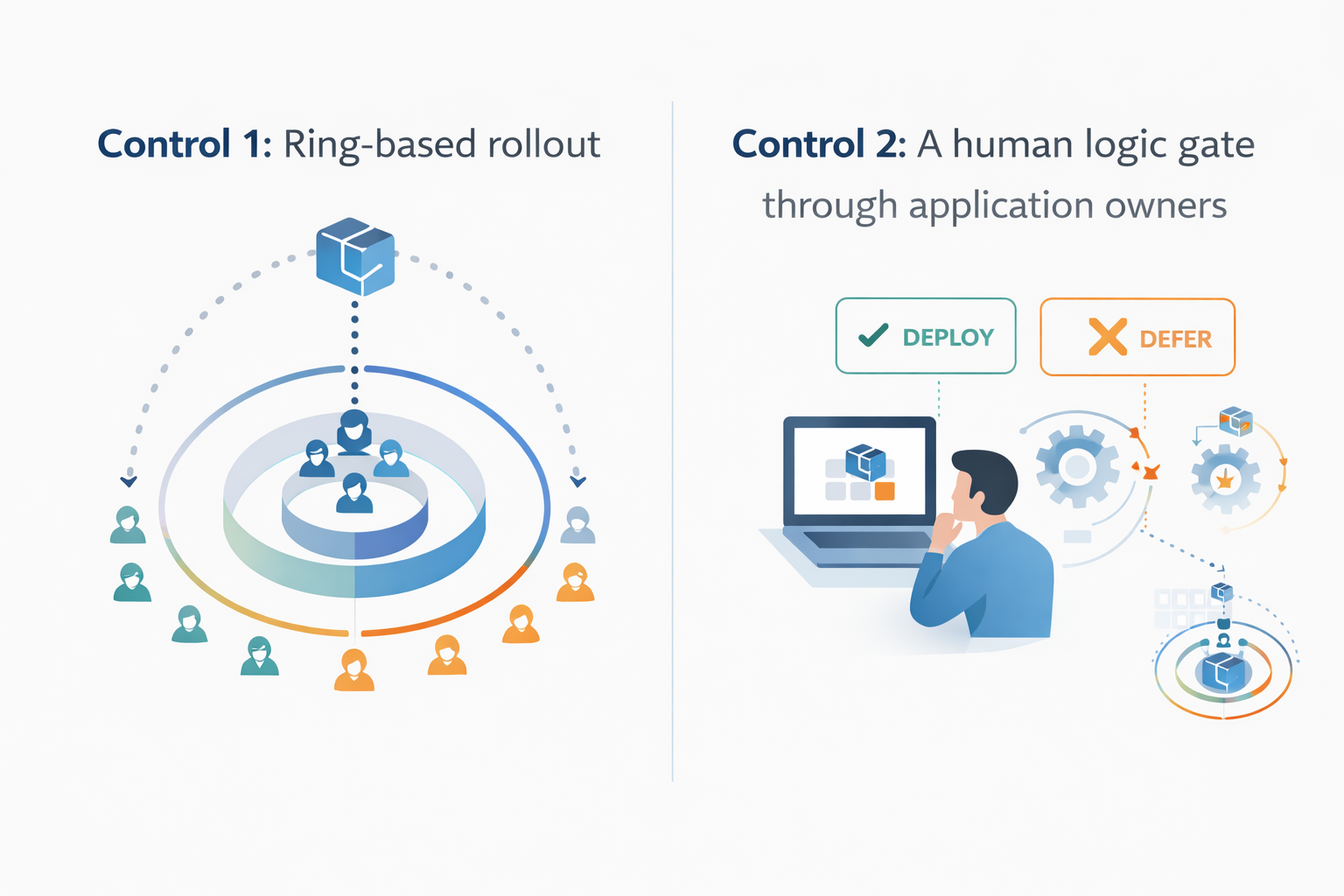
Two in particular do most of the heavy lifting: a phased rollout through rings and a human decision point on whether a non-security update is worth deploying now.
Control 1: Ring-Based Rollout as a Safety Mechanism
If packaging speed increases, the organisation needs a reliable way to safely absorb that speed. Ring-based deployment is one of the simplest and most effective ways to do that.
The principle is straightforward. Deploy to a small group first, observe the outcome, then expand gradually. If there is a problem, the effect is contained. If the update behaves as expected, rollout can continue with increasing confidence.
That is what makes rings so valuable. They reduce blast radius without forcing every change into a slow, central approval process. They create space to detect problems early, stop a rollout if needed, and learn from real-world behaviour before broad deployment.
Used properly, rings are the safety valve for speed. They allow teams to move faster without giving up control.
Control 2: The Role of Application Owners in Modern Change Control
The second control is more selective. Not every available update deserves deployment simply because it can be packaged and tested quickly.
Security fixes and high-risk remediation should usually move fast. But many feature updates, minor vendor changes, and lower-priority releases do not always justify immediate deployment. Someone still needs to decide whether the change is useful enough, timely enough, and relevant enough to introduce into the environment.
That is where application owners can play an important role.
They are often best placed to judge whether a feature change is relevant, whether users are asking for it, whether there is a good operational window for deployment, or whether the update can wait. That helps filter noise without slowing down the packaging process itself.
Just as importantly, deciding not to deploy immediately does not reduce the value of having a tested package ready to go. Circumstances change. A deferred update may become more relevant later due to a support issue, a policy shift, a security concern, or a change in business priority. Having the package already prepared preserves speed and flexibility without forcing immediate action.
Further reading: Harnessing Your Expert Application Packagers: From Manual Operators to Automation Architects [Read the blog]
A Practical Framework for Update Decisions
Once packaging speeds up, organizations need a simple way to distinguish urgent updates from optional ones. It does not need to be complex.
-
Fast-track: security updates, high-risk fixes, and changes that clearly reduce exposure or correct significant issues.
-
Review: feature updates, functional changes, and non-urgent improvements where someone should decide whether the benefit justifies the operational effort, timing, or possibility of disruption.
-
Defer: low-value noise, minor changes with limited practical benefit, or updates that can reasonably wait for a later cycle.
That kind of framework helps teams stay modern without treating every available update as equally urgent. It also makes change control more credible, because the organisation is applying judgement rather than just reacting to volume.
Building Structure Around Speed
Faster packaging only works well if deployment decisions scale with it. That means using rollout rings to manage release risk and giving application owners a clear role in deciding which non-security updates should move now versus later.
The goal is not to review every update individually. It is to put the right controls around a faster process.
Check out my walkthrough of the App Owner + App Readiness Integration demo
(Opens in YouTube)
.png?width=6668&height=3748&name=AI%20Featured%20Image_AIJournal_Article%20(1).png)

.png?width=1200&height=627&name=Mythos_Featured%20Image_Blog_The%20AI%20Patch%20Wave%20Head%20of%20EUC%20(2).png)