

If every application update, packaging request, and remediation task has to pass through a single expert team, the operational impact is predictable. Work queues grow, priorities compete, and the business waits.
This is not a performance issue. It is a structural limitation in how many organisations approach Windows Application Management.
A small number of specialists are positioned as the control point for an application estate that is constantly changing and growing. As application volumes increase and update cycles accelerate, that model does not scale. The result is delay, inconsistency, and growing exposure.
The question is not how to push more work through the same bottleneck. It is about removing the bottleneck entirely.
The Limits of Manual Application Packaging at Scale
Many organisations respond to packaging pressure in predictable ways. They try to work harder, prioritise more tightly, or add headcount.
These approaches create marginal improvement at best.
Application portfolios are too large. Update frequency is too high. The cost of delay, particularly from a security and compliance perspective, is too high.
When application packaging remains heavily manual, the outcomes are consistent:
- Slower application updates
- Partial or inconsistent coverage
- Increasing backlog of requests
- Prolonged exposure to known vulnerabilities
This is not a temporary challenge. It becomes the operating model.
The Role of the Application Packager is Changing
Automation does not remove the need for expert packagers. It changes where their expertise delivers the most value.
In a manual model, expert packagers act as operators. They receive requests, inspect installers, build packages, test outcomes, resolve issues, and repeat the same sequence across a growing queue of applications. This work requires deep expertise, which is precisely why it becomes difficult to scale.
In a more mature model, that same expertise moves upstream.
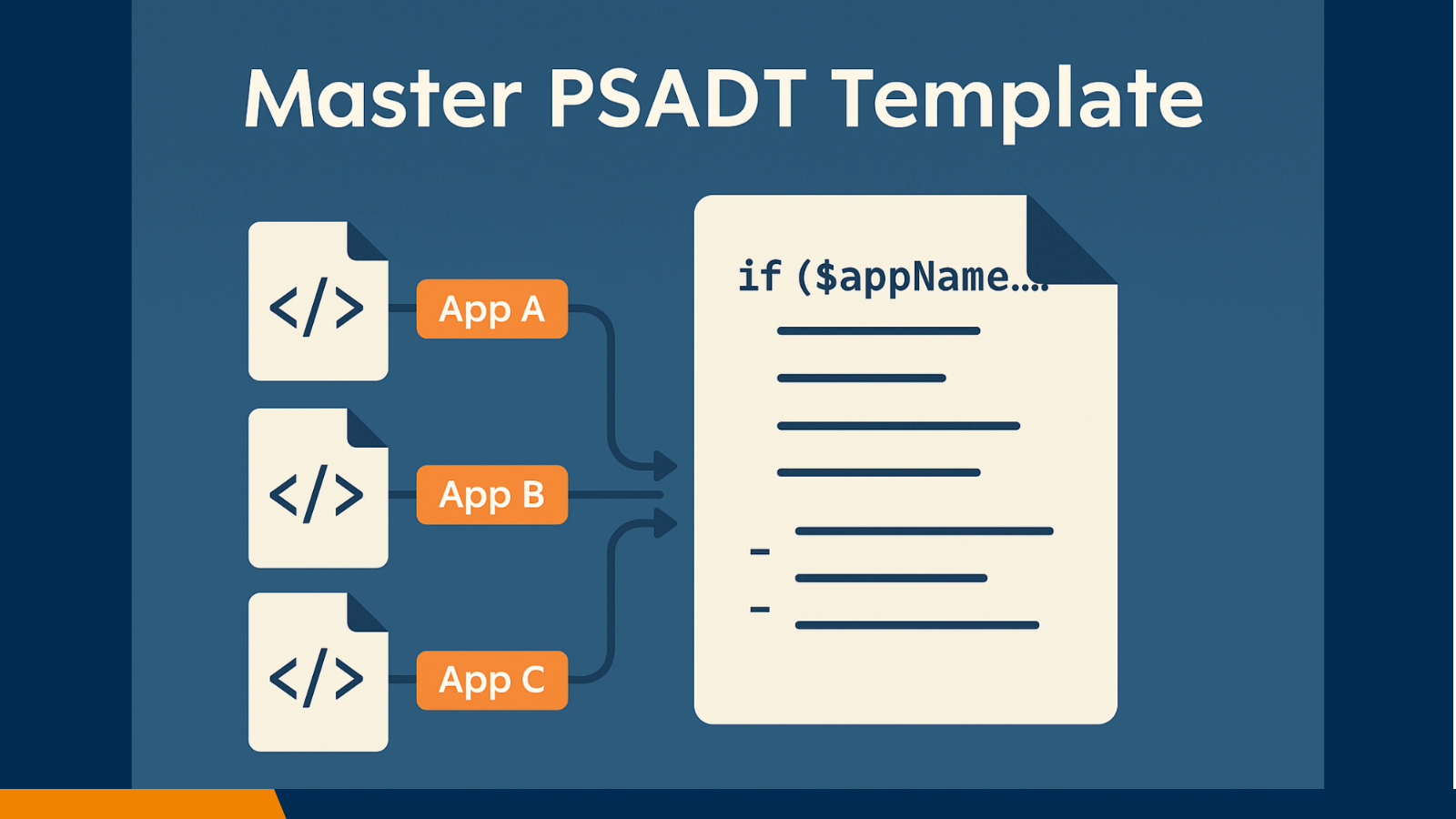
Expert packagers define how packaging should work, not just how to complete individual packages. They establish standards, design workflows, and govern how applications move through packaging, testing, and validation.
Their role shifts to control and optimisation rather than throughput.
This shift matters. It replaces a dependency on individual effort with a system that can improve over time.
What Application Packaging automation actually unlocks
At a leadership level, application packaging automation is not simply about doing the same work faster. It changes what the function can realistically deliver.
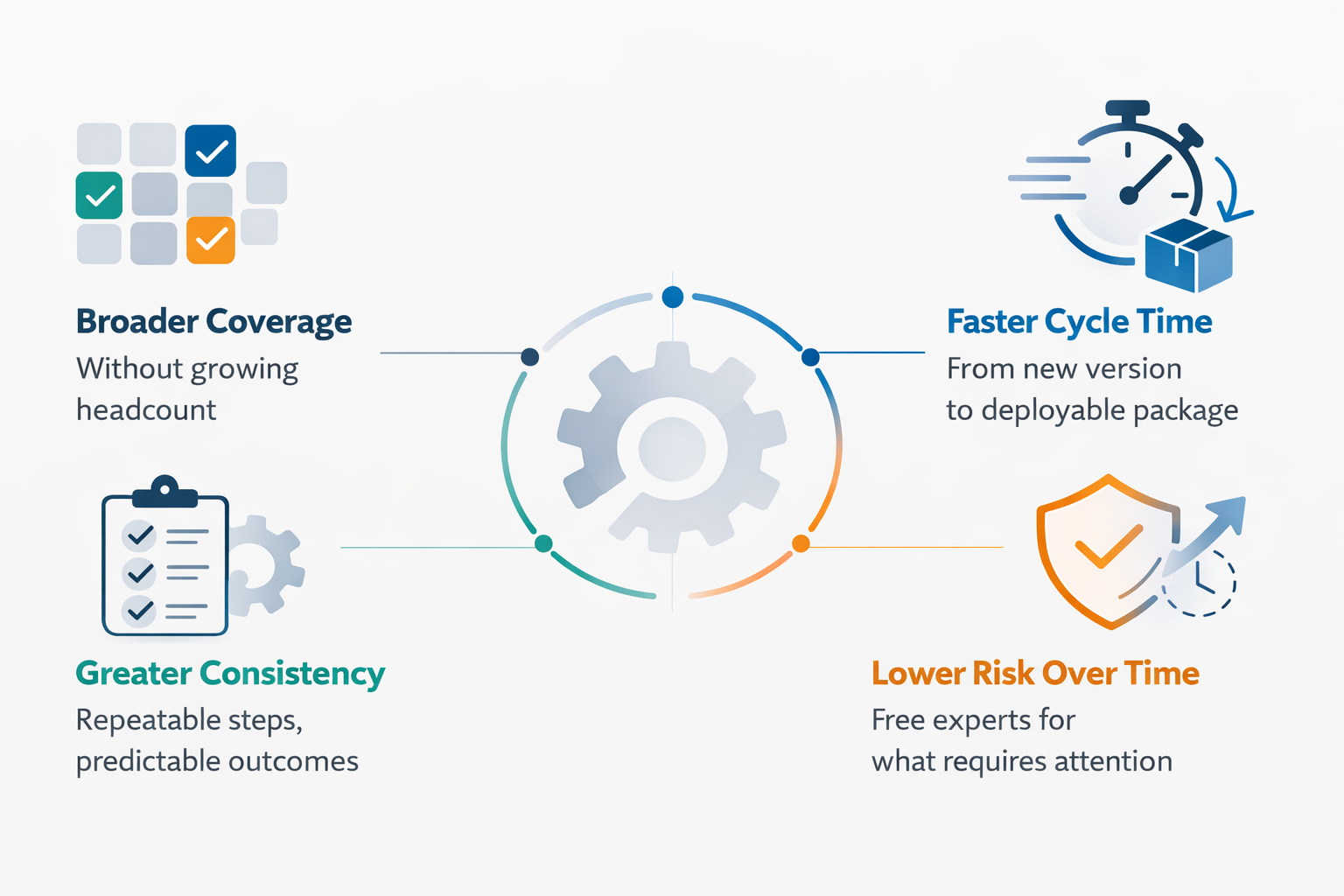
First, it expands coverage. When repeatable applications can move through a defined automated path, organisations are no longer forced to ignore or delay large portions of the application estate. Coverage becomes a function of design, not capacity.
Second, it reduces the time between a new version being available and a deployable package being ready. This improves responsiveness and limits the time outdated applications remain in the environment.
Third, it introduces consistency. Manual packaging at scale inevitably leads to variation. Different approaches, different assumptions, and inconsistent documentation are difficult to avoid. A controlled workflow enforces repeatable steps and predictable outputs, improving quality, supportability, and audit readiness.
Finally, it reduces risk over time. Evergreen application management is difficult to achieve when every update competes for specialist attention. When common update paths are automated, the packaging team can focus on the applications that genuinely require expert intervention.
If you want to see how this works in practice, [Explore Juriba App Readiness] and how it enables automated packaging, testing, and publishing at scale.
Where Self-Service Application Packaging Can Fit
For some organisations, the next step is enabling controlled self-service.
This does not mean application owners are expected to package applications. It means they can initiate a governed process that has already been defined by the packaging team.
The standards, packaging logic, testing sequences, and validation points remain unchanged. What changes is who can start the process.
This is a subtle but important shift. It reduces administrative overhead on the packaging team while improving accountability across the organisation. Requests are no longer handed off into a queue with limited visibility. They move through a structured workflow with defined outputs and clear ownership.
Used correctly, this is not a loss of control. It is a more scalable form of it.
Leveraging application owners more is more likely to succeed when you have a well managed application owner program. Check out [App Owner] to effectively track coverage, participation, and outcomes.
The Reality: Not Everything Can Be Automated
Not every application will fit a standard automation path.
Some installers are poorly structured. Some applications introduce complex dependencies or require environment-specific handling. Others demand remediation steps that cannot be standardised.
These cases will always require expert attention.
That does not weaken the case for automation. It clarifies it.
The advantage lies in separating what should be automated from what genuinely requires expertise. The stronger the automated path becomes for the majority of applications, the more capacity is created for the minority that truly need hands-on intervention.
A Practical Approach to Scaling Application Packaging
The most effective approach is pragmatic.
Start with the applications that are best suited to automation:
- Common across the estate
- Repeatable in structure
- Well understood from a packaging perspective
From there, define the system around them. Establish standards, build controlled workflows, and create clear exception paths.
This allows expert packagers to focus their time where it delivers the most value, rather than being consumed by work that could be handled in a more scalable way.
The goal is not full automation. It is majority automation, supported by expert intervention where it matters most.
Final Thought: From Bottleneck to Scalable Capability
Application packaging does not need more effort. It needs a different operating model.
By shifting expert packagers from manual operators to automation architects, organisations can move beyond the constraints of traditional approaches. Coverage improves. Consistency increases. Risk is reduced. And the function becomes capable of scaling with the demands placed on it.
If you want to understand what this looks like in your environment, [Book a Packaging Maturity & Benchmark Session] to assess your current approach, identify gaps, and map a path to scalable application management.
.png?width=6668&height=3748&name=AI%20Featured%20Image_AIJournal_Article%20(1).png)

.png?width=1200&height=627&name=Mythos_Featured%20Image_Blog_The%20AI%20Patch%20Wave%20Head%20of%20EUC%20(2).png)