
Key takeaways:
- Microsoft’s June 2026 Patch Tuesday addressed 200-plus CVEs, with CrowdStrike and CyberScoop counting 206, the largest total in the program’s 23-year history. Other researchers counted the month slightly differently, which is why the body includes the methodology caveat.
- AI and automation are accelerating vulnerability discovery. Public reporting tied CVE-2026-49160 to OpenAI’s Codex and associated researchers.
- Tenable expects 100-plus CVE months to become more common.
- For IT teams, the operational impact is more vendor releases to assess, package, test, publish, and manage. Manual, selective patching will struggle to keep pace.
- The response has to be a continuous application-management process that automates repeatable work and keeps specialists focused on the exceptions.
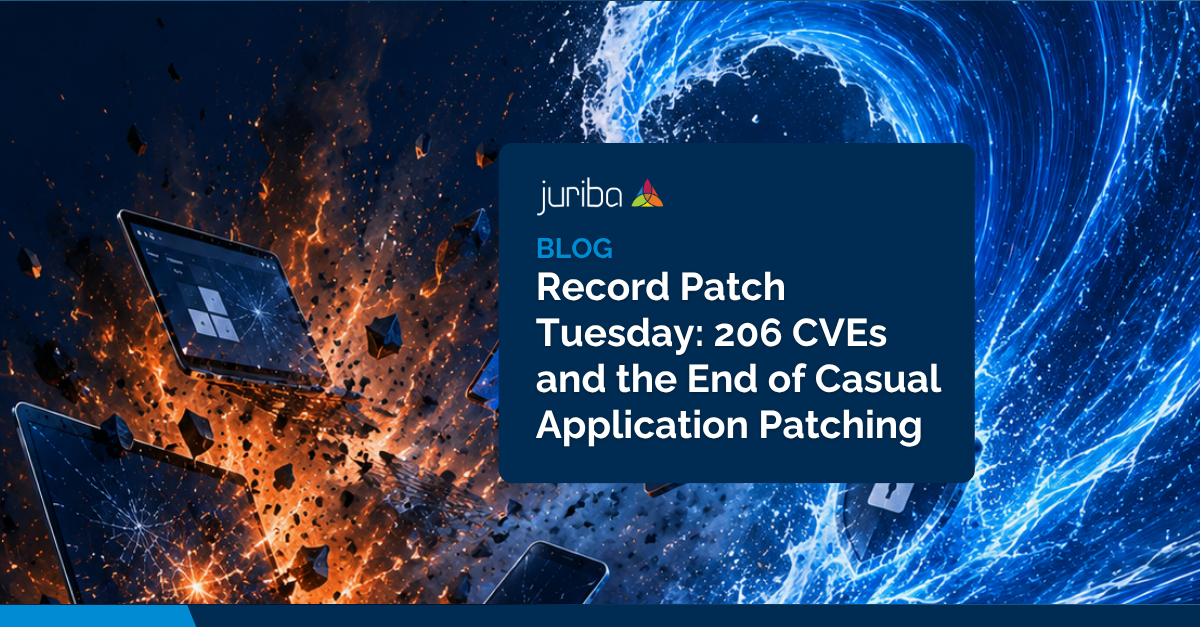
On June 9, 2026, Microsoft delivered a Patch Tuesday that should get every Windows application management leader's attention. CrowdStrike and CyberScoop counted 206 vulnerabilities, the largest Patch Tuesday total in the program's 23-year history. SANS counted 204. ZDI counted 208. Those differences come down to methodology; all three put June well above the usual monthly load.
More than 30 of the vulnerabilities were rated Critical, and three were publicly disclosed zero-days. At least one, CVE-2026-50507, had proof-of-concept code available at release.
In May, I wrote about Claude Mythos and the downstream application update problem created by AI-assisted vulnerability discovery. June's Patch Tuesday is seeing that prediction start to materialize earlier than many may have expected. Faster vulnerability discovery creates more vendor responses, which eventually become more enterprise update work.
If you manage a Windows application estate, a 200-plus CVE month means more advisories to review, more vendor releases to track, more packaging decisions, more version exceptions, more dependency questions, and less room for casual, selective patching.
The June numbers were hard to ignore
-
206 vulnerabilities by CrowdStrike and CyberScoop's count; 204 by SANS; 208 by ZDI.
-
37 Critical vulnerabilities and three publicly disclosed zero-days by CrowdStrike's count; Microsoft was not aware of active exploitation for those three on release day.
-
CVE-2026-50507 had proof-of-concept code available at release.
-
Microsoft also incorporated roughly 360 Chromium vulnerabilities into Edge outside the core Patch Tuesday count.
-
Google's June 2 Chrome desktop release included 429 security fixes.
-
Public reporting after the June release highlighted another Defender zero-day with proof-of-concept code attributed to Nightmare Eclipse, also known as Chaotic Eclipse.
Why the pace is changing
Microsoft has already said vulnerability discovery is accelerating across the software industry. AI is part of that shift, alongside better automation, broader researcher participation, internal security investment, and coordinated disclosure.
June gave us a public example. CVE-2026-49160, an HTTP.sys denial-of-service vulnerability was publicly disclosed and, according to reporting on Microsoft's advisory, credited to OpenAI's Codex and associated researchers.
We do not need every vulnerability to be AI-discovered for the impact to show up in enterprise IT. The economics of finding bugs are changing. The resulting work shows up in enterprise IT as more releases to assess, package, test, publish, and support.
Tenable's Satnam Narang has framed 100-plus CVE months as a likely baseline for 2026 and beyond. That forces an uncomfortable planning assumption: occasional 200-plus-CVE months are possible, and application teams cannot rely on the old rhythm of manually pushing update work through as time allows.
Prioritization has a ceiling
Most organizations manage update volume by prioritizing. Security fixes jump the queue; feature releases and minor versions wait. That model made sense when the security workload stayed contained.
As more routine vendor releases carry security context, prioritization starts to look less like a strategy and more like backlog management.
Not every CVE turns into an application package. Enterprise teams experience the impact as a wider flow of vendor releases, dependency updates, installer changes, version exceptions, testing needs, support tickets, and rollback decisions across the estate.
After the CVEs are triaged, EUC and application teams need a repeatable update path: identify deployed versions, determine exposure, source the installer, package or wrap the update, validate installation and removal behavior, handle exceptions, and publish through the right channel.
Patch catalogs are helpful, where applicable
Patch catalogs are genuinely useful for common commercial software. Use them.
But enterprise estates include niche tools, regional applications, legacy installers, gated vendor downloads, middleware components, internal utilities, and bespoke packages that never show up in a catalog. Those applications are where update work gets messy and where many teams fall back to tickets, spreadsheets, and heroic packagers.
The catalog conversation usually focuses on app counts. The better test is coverage of your actual estate: the common apps, the awkward apps, the gated apps, and the inherited apps nobody has touched in years.
That gap is where migrations slip, security exceptions pile up, and app ownership becomes a scavenger hunt.
The end of casual application patching
Casual application patching is the habit of treating updates as occasional work: wait for an event, pick the obvious security items, process what is urgent, and leave the rest for later.
That posture gets harder to defend as AI-assisted discovery increases vendor pressure and heavier vendor response increases change across enterprise estates.
Human judgment remains essential for risk acceptance, sequencing, business validation, and true exceptions. It just cannot be required for every step of every update.
Build for constant change
Application teams need enough automation and process discipline to absorb routine change continuously:
- Keep a real view of the application estate, including apps outside catalog coverage.
- Use catalogs where they help and have a path for gated, niche, legacy, and internal applications.
- Automate repeatable packaging, wrapping, validation, and publishing work wherever possible.
- Standardize the update path so specialists spend their time on exceptions, sequencing, and business-specific decisions.
- Treat application patching as BAU, not an emergency project that restarts every month.
June's Patch Tuesday did not create the problem; it made the problem easier to see. The old pattern - selective, mostly manual application patching around the edges of the estate - was already under pressure. AI-assisted discovery and heavier vendor update cycles will keep tightening that pressure.
Application patching has to become a continuous operational discipline. The teams that get there first will absorb record months without rebuilding the process every time the next vendor advisory lands.
Further reading:
Read the full briefing: "The Coming Application Update Wave"

Frequently asked questions
How many vulnerabilities did Microsoft fix in the June 2026 Patch Tuesday?
By one widely cited count, Microsoft addressed 206 vulnerabilities in June 2026, while other researchers counted the month slightly differently depending on methodology. CrowdStrike counted 37 Critical vulnerabilities and three publicly disclosed zero-days; at least one had proof-of-concept code available at release.
Why are Patch Tuesdays getting bigger?
AI and automation are accelerating vulnerability discovery, alongside broader researcher participation, coordinated disclosure, and internal security investment. Microsoft says its engineers and the wider security community are increasingly using AI tools to find bugs; public reporting tied CVE-2026-49160 to OpenAI’s Codex and associated researchers. Tenable’s Satnam Narang expects 100-plus CVEs per month to become routine.
What does the AI patch wave mean for enterprise IT teams?
More vendor fixes mean more enterprise updates to assess, package, test, and deploy. Selective, mostly manual patching can’t scale into a sustained wave, so patching has to become a continuous, automated discipline.
How does Juriba support enterprise customers?
Juriba helps enterprise IT teams connect application visibility, ownership, readiness, workflow, deployment, and evidence. That matters as application change becomes more continuous and AI-assisted vulnerability discovery increases pressure on already-stretched teams.
Claude Mythos may accelerate vulnerability discovery. The organizations that succeed will be those that can absorb the resulting application change while maintaining visibility, ownership, governance, and control.
Juriba App Readiness helps teams automate repeatable packaging and testing activities, while keeping skilled people focused on exceptions, business judgment, compatibility, and risk-based decisions. The result is a stronger operating model for handling application change at scale.
Sources
- Juriba, Claude Mythos, AI Vulnerability Discovery, and the End of Casual Application Patching
- Microsoft Security Response Center, A note on this month's Patch Tuesday
- CrowdStrike, June 2026 Patch Tuesday: Microsoft Patches 206 Vulnerabilities, Including Three Publicly Disclosed Zero-Days
- CyberScoop, Microsoft breaks Patch Tuesday record with 206 vulnerabilities
- SANS Internet Storm Center, Microsoft June 2026 Patch Tuesday
- Zero Day Initiative, The June 2026 Security Update Review
- Rapid7, Patch Tuesday - June 2026
- Google Chrome Releases, Stable Channel Update for Desktop, June 2, 2026
- Krebs on Security, A Record-Breaking Patch Tuesday for June 2026
- TechRadar, Microsoft says it is hard at work on a patch for this Defender zero-day
- Dark Reading, Blame AI: Patch Tuesday Hits Record 206 CVEs

.png?width=6668&height=3748&name=AI%20Featured%20Image_AIJournal_Article%20(1).png)

.png?width=1200&height=627&name=Mythos_Featured%20Image_Blog_The%20AI%20Patch%20Wave%20Head%20of%20EUC%20(2).png)